

by 27.Works
17, June, 2026 – For immediate release
THEON DESIGN AND BRINKWORTH EXPLORE WHY ANALOGUE ICONS STILL MATTER
- Theon Design founder Adam Hawley and Brinkworth founder Adam Brinkworth discuss the parallels between architecture and automotive design
- Founder-to-founder conversation explores why reimagined classics continue to attract modern luxury consumers
- The founders shared a philosophy of preserving what matters while adapting for contemporary use
- The discussion examines restraint, longevity and authenticity as defining qualities of modern luxury
- Insights are provided into the growing appeal of analogue experiences in an increasingly digital age
- Hosted by journalist Gary Inman at Brinkworth’s East London headquarters
Why are some of the world’s most discerning clients increasingly drawn to analogue experiences in an increasingly digital world?
That question formed the basis of a recent conversation between Adam Hawley, founder of Theon Design, and Adam Brinkworth, founder of global design company Brinkworth, hosted by journalist Gary Inman.
Held at Brinkworth’s East London headquarters and the surrounding streets that have long served as a centre for creative culture, the discussion explored the parallels between architecture and automotive design, examining how both disciplines approach heritage, reinterpretation and longevity.
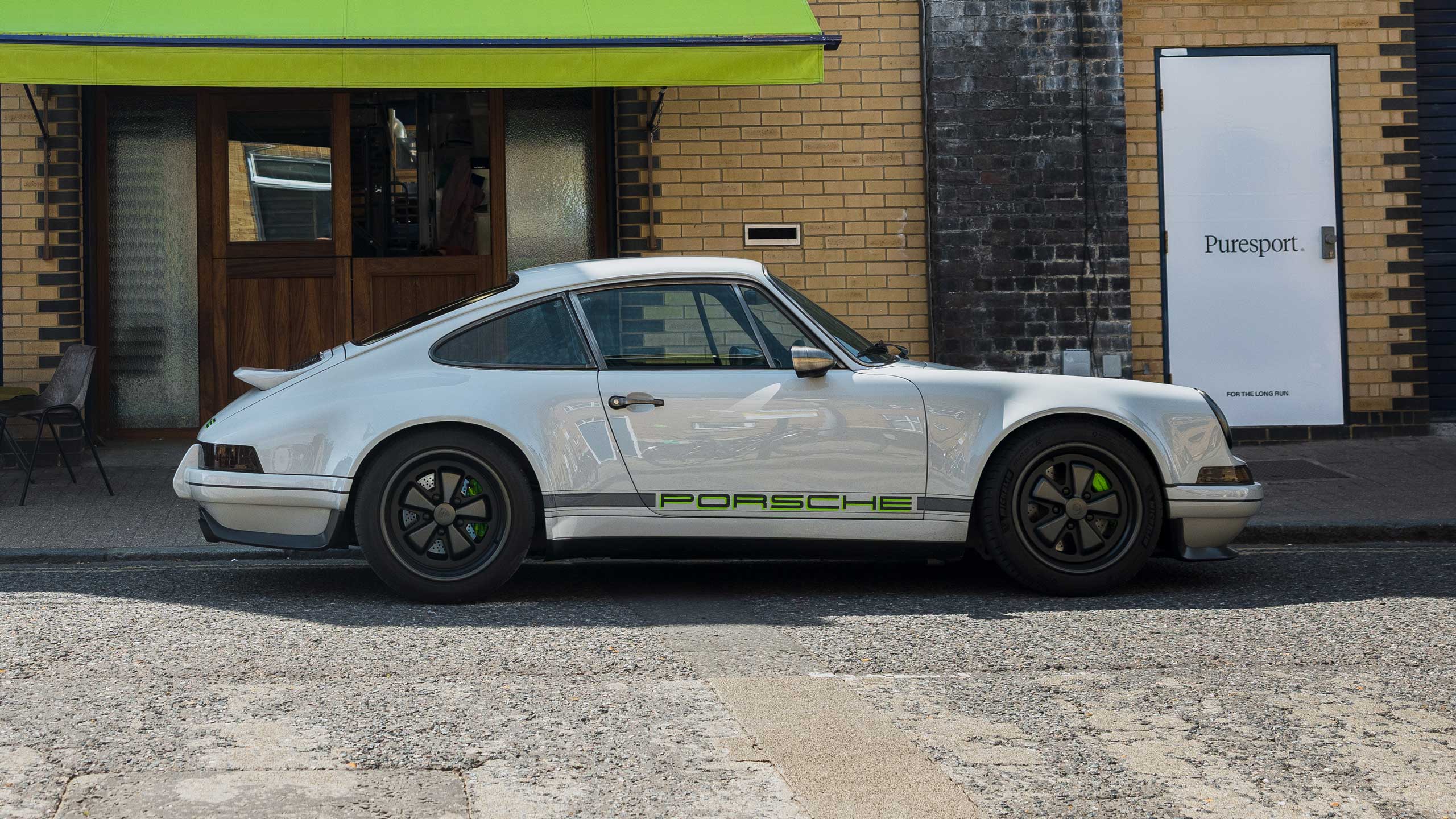
For Theon Design, the conversation comes at a time when demand for carefully re-engineered air-cooled Porsche 911s continues to grow. Despite the pace of technological development and electrification in the automotive industry, clients are increasingly seeking objects that prioritise tactility, craftsmanship and emotional connection.
No stone is left unturned
Virtually every body panel of the car is an augmented shape, from the more muscular rear three-quarters with their contemporary sharp radiused wheel arches, to the artfully extended bonnet. The majority of the body panels, including the roof, are exclusive Theon Design lightweight carbon fibre.
At its heart is a naturally aspirated 4.0-litre flat-six producing 421 bhp, but the story extends far beyond performance figures. Through careful engineering and the extensive use of carbon fibre, the car weighs just 1,146 kg – more than 300 kg lighter than a current Porsche 911 GT3. Despite this focus on lightness, the interior remains richly appointed, trimmed using 12 hides of premium leather and tailored entirely to its owner’s brief.
A meeting of creative minds
The discussion highlighted a shared philosophy between the two businesses: respecting an original idea while making it relevant for contemporary use.
“Creatively, we’re often working with historic structures,” explained Adam Brinkworth. “The first thing we ask is what’s good about this building? What should be preserved? What still has value? Then we think about how to make it useful and relevant for today. It occurs to me that’s very similar to what Theon does.
“I like that Theon utilises contemporary materials because that’s the most functional. And sometimes the contrast between two languages, modern and historic, can be complimentary and aesthetically beautiful.”
That balance between preservation and evolution sits at the heart of Theon’s approach.
“Our identity is based around subtlety,” said Adam Hawley. “The classic Porsche shape is already a subtle thing. I don’t see the point in trying to reinvent it. The challenge is understanding what made it great in the first place and then refining every single aspect without losing its character.”
Reimagined classics – a movement
The conversation also explored why reimagined classic cars continue to resonate with modern audiences, particularly as products and experiences become increasingly digital.
“The whole point of a classic Porsche 911 is the engine,” Hawley continued. “It’s the heart and soul of it. I think the more we move into a digital era and towards electric vehicles, the greater the appetite becomes for analogue experiences like the ones we create. We breathe a whole new lease of life into a proven recipe – taking lots of design inspiration from the competition cars of the late 1970s and early 1980s.”
For Brinkworth, the appeal extends beyond nostalgia.
“There’s nothing wrong with enjoying something for what it was,” he explained. “But the interesting question is asking what would work now, and what might work in the future. Then adapting accordingly.”
The art of restraint
The discussion also touched on the importance of restraint in modern design.
“Sometimes the best way to stand out is by being quieter,” said Brinkworth. “If everybody is shouting, contrast can come from restraint. Sometimes maximalism is the right approach, and we enjoy designing stuff that’s over the top, but we also like being super restrained.”
That philosophy is reflected throughout Theon’s work. While the market for re-engineered Porsche 911s has become increasingly crowded, the Oxfordshire-based company has established a reputation for understated, highly personalised commissions that prioritise coherence over spectacle.
Each Theon commission is developed through a close collaboration between client and studio, resulting in a car that is tailored far beyond its visual specification. Engine response, suspension behaviour, steering feel and overall character are all calibrated around individual preferences, creating a deeply personal interpretation of the air-cooled 911.
“We even tune the way the engine behaves to suit the client,” Hawley explained. “The suspension might be configured more for touring or more for sporting use. Two clients can specify the same engine and gearbox, but the finished cars can still feel completely different. When a journalist drives one of our cars, they’re not really driving a Theon. They’re driving its owner’s interpretation of what the ideal air-cooled 911 should be.”
Brinkwirth added, “I’ve owned a fast Porsche. I have invested a lot trying to create one that could be a road car and a race car, and it ended up being neither, so when talking about the experience, it’s not about out-and-out speed, it’s not the numbers, it’s how something feels.”
Preserving what matters
For both founders, the conversation ultimately centred on a simple idea: the enduring appeal of thoughtful design. Whether creating a building, a retail space or a reimagined sports car, the objective remains remarkably similar.
Understand what matters. Respect it. Then improve it.
About Theon Design
Theon Design, founded by Adam Hawley and Lucinda Argy, specialises in delivering bespoke commissions based on the Porsche 911 (964). Hawley, a car designer who has worked for numerous OEMs globally, and Argy, a marketing and business development specialist, started the business in 2016. Operating from a state-of-the-art facility in Deddington, Oxfordshire – nestled in the heart of the UK’s ‘Motorsport Valley’- Theon Design’s expert in-house team builds bespoke commissions for a global clientele, leveraging cutting edge technologies and premium suppliers.
Theon comprises experts in automotive design, engineering, engine and chassis development, along with trim and vehicle manufacturing. It is driven by a desire to build the perfect air-cooled Porsche 911, one that combines the aesthetics and analogue driver involvement of a classic with modern comfort, driveability and performance.
Over the last two years, Theon Design has significantly expanded its production capabilities with the opening of a new, purpose-built facility, and a series of expert new staff joining the team. Theon Design’s expansion is driven by surging international demand for its bespoke, exactingly developed, design-led Porsche 911 (964) based commissions, which are offered for sale in every major global territory.
The price of a Theon commission does not include the donor car (which is either supplied by the customer, or Theon can assist with sourcing a vehicle if required) and local taxes. The company also offers full Porsche restorations.
Theon Design is fully respectful of Porsche’s engineering ethos and model heritage. Out of respect for Porsche, and to respect Porsche’s trademark rights, Theon Design cars should never under any circumstances be referred to or described as a “Theon”, “Theon 911”, “Theon Porsche 911” or a “Porsche Theon 911,” or in any other manner that suggests that it is anything but a Porsche® 911®.”
Theon Design is not connected in any way with Dr. Ing. h.c.F Porsche AG. It does not imply that any Theon Design commission is the product of Porsche AG. Porsche and the Porsche crest are registered trademarks of Porsche AG. The Porsche® name and crest and 911® are trademarks of Dr. Ing. h.c.F. Porsche AG, and any other products mentioned are the trademarks of their respective holders. Any mention of trademarked names or other marks is for the purpose of reference only.
ENDS